What Is Commodity Content?
Written by: Ryan Jones
Get Started with SERPrecon
Get Started for FreeWhat Is Commodity Content?
Commodity content is content that doesn't say anything new or add to the conversation. It's content anyone could have written: the same facts in roughly the same words as every other page ranking for the query. It isn't wrong. It's not bad It just isn't additive, and nothing about it makes it the best search result.
Google has been hinting about commodity content for years. In 2026 they finally put the term in writing. Google's official guide to generative AI search now tells site owners to create "non-commodity content" and calls that the factor most likely to shape their AI search presence in the long run.
That raises the question every SEO should be asking: if Google can tell commodity content apart, how? And can you check your own page before you publish it? You can. SERPrecon already calculates a commodity score for your page and every page it's competing against.
Commodity content goes by many names. information retrieval scientists may use words like "information gain" and "max marginal relevance" while SEOs may use simplified terms like EEAT - but they're all talking about the same thing. These varying definitions have created a ton of debate in the SEO industry lately.
What Google says about commodity content
Google has used the phrase in three places worth knowing.
1. The official AI search guide (May 2026)
Google's Search Central guide, Optimizing your website for generative AI features on Google Search, has a section titled "Create valuable, non-commodity content for your audience." Google says that creating unique, compelling and useful content will likely influence your AI search presence more than any other suggestion in the guide.
It also gives a clear pair of examples:
Commodity: "7 Tips for First-Time Homebuyers." Built on common knowledge that could come from anyone.
Non-commodity: "Why We Waived the Inspection & Saved Money: A Look Inside the Sewer Line." Only someone with that first-hand experience could write it.
The guide's other advice points the same way: bring a unique point of view, draw on your own knowledge and experience rather than restating what's already out there, and don't mass-produce pages to manipulate rankings. Google announced the guide on its Search Central blog, highlighting "valuable, unique, non-commodity content" as a core theme.
2. Danny Sullivan on Search Off the Record
On Google's Search Off the Record podcast, John Mueller asked Danny Sullivan what creators should focus on in the age of AI. According to Search Engine Journal's write-up, Sullivan said commodity content "isn't going to necessarily be your strength" and that creators should lean on what's original about them. His example: pages that wrapped a long preamble around the Super Bowl's start time, which offered nothing anyone else couldn't.
3. John Mueller, all the way back in 2019
This isn't a new idea. In 2019, Mueller told a site owner whose pages looked like everyone else's that they needed to differentiate themselves, especially with commodity content. As Search Engine Journal reported, his test was simple: what would make your site the objectively best result for the query? Just being the same as the others isn't enough.
What Google doesn't say
Google never says commodity content is penalized, and it doesn't publish a "commodity score." Plenty of commodity content still ranks, because sometimes a quick, common answer is what the searcher wants. The message is about advantage: when ten pages say the same thing, nothing makes yours the one to rank or cite.
For decades SEOS have relied on pumping up pagerank and authority signals to compensate for their commodity content - but with AI relying less on link signals, SEOs are going to need to learn how to address these issues from the content and authority side. So let's dive into it.
How a search engine could measure commodity content
Google doesn't tell us how it spots commodity content. But "commodity" is really a measure of redundancy: how much a page repeats what the other candidate pages already say. Search engines have been measuring redundancy for decades, and the public record shows several ways they do it.
Near-duplicate detection
The bluntest form is spotting pages that are nearly identical. In 2007, Google engineers Gurmeet Singh Manku and Arvind Jain, with Anish Das Sarma of Stanford, published Detecting Near-Duplicates for Web Crawling. It uses simhash fingerprints, which give similar documents nearly identical fingerprints, so a crawler can quickly tell whether a new page is basically one it already has.
Commodity content is a softer version of the same problem. The page isn't a duplicate, but large stretches of its phrasing overlap with pages already in the index. Since 2007, Google has switched to passage indexing which allows a lot more granular level of detecting commodity content.
Information gain
Google's patent US11354342B2, "Contextual estimation of link information gain" describes scoring how much new information a document adds beyond documents the user has already seen. The patent says results may be ranked at least in part on that score, and documents that add nothing new can be demoted after the user has seen similar ones.
That maps neatly onto AI search citations. When an answer engine has already pulled three sources that say the same thing, a fourth page saying it again adds no information gain. A page with a fact, test or angle the others lack does.
An originality score in the Google leak
The 2024 leak of Google's internal Content Warehouse API documentation included an attribute called OriginalContentScore. As Mike King's analysis reports, it's stored as a 0–127 value and present only on pages with little content. Of course the leak doesn't show how, or whether, it's weighted in ranking, so treat it as evidence that Google models originality, not as a confirmed ranking factor.
Diversity when choosing sources
Retrieval systems also try not to show the same thing twice. A standard technique called maximal marginal relevance (MMR) picks each next result by balancing relevance against similarity to what's already been picked. Whether or not Google uses that exact method, the principle is the same: once the common answer is covered, the next slot goes to something different.
Putting it together
Across all of these, a page looks like commodity content when it:
Shares a lot of its phrasing with the other pages competing for the query.
Has little that no one else has: few phrases, facts or angles unique to it.
Uses a narrow, repetitive vocabulary, circling the same handful of terms instead of covering the topic with depth.
Those three ideas are exactly what SERPrecon measures.
How SERPrecon's commodity score works
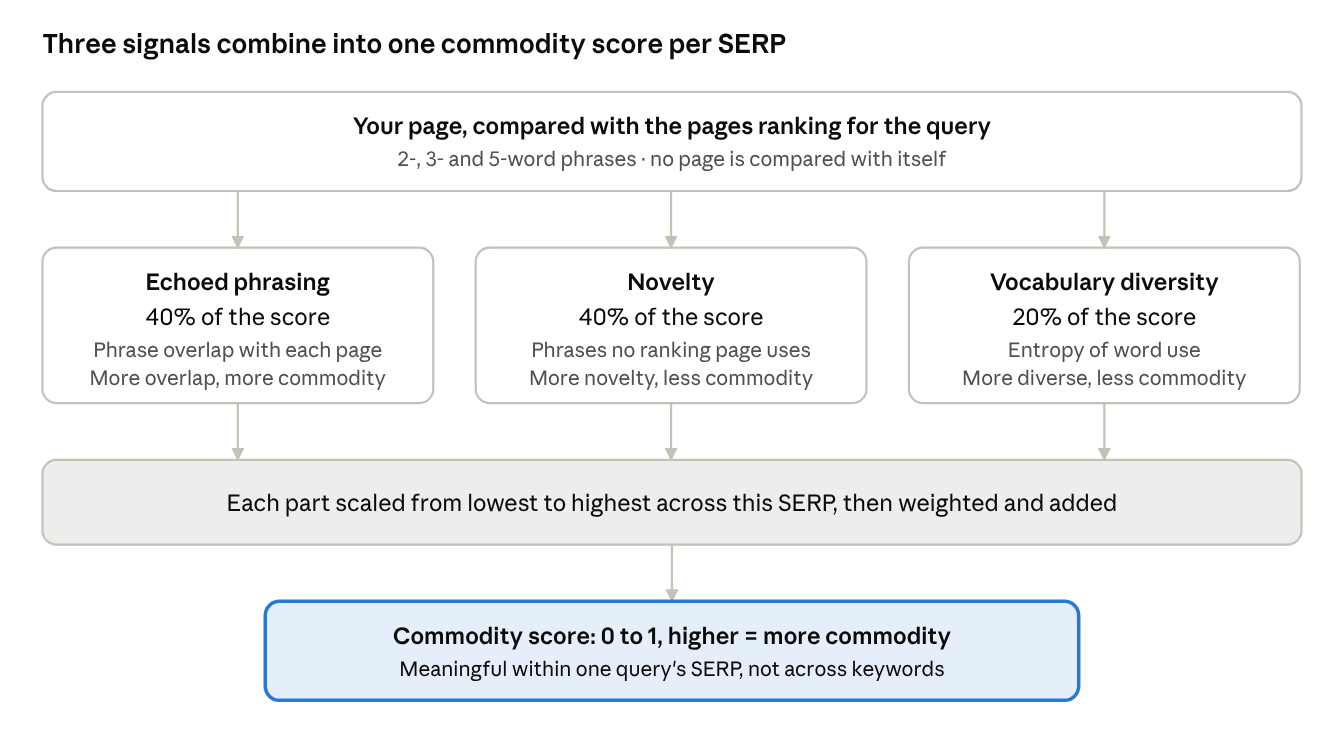
SERPrecon calculates a commodity score for your page and for every page ranking for your query. It runs from 0 to 1, and higher means more commodity. In plain English, your page scores high when it echoes the phrasing of the pages already ranking, has little phrasing no one else uses, and writes with a narrow vocabulary.
Here's what goes into it.
1. Echoed phrasing
We break each page into overlapping word sequences (n-grams) of 2, 3 and 5 words. Then we measure how much of your page's phrasing overlaps with each ranking page, using Jaccard similarity (the shared phrases divided by all phrases across both pages), and average it across the SERP. Common words like "the" and "of" stay in here, because phrasing is the point: "the best way to" repeated across ten pages is exactly what commodity content sounds like.
This is the same family of measurement as near-duplicate detection, tuned for overlap instead of copies.
2. Novelty
Next we count the share of your 2-, 3- and 5-word phrases that appear on no ranking page at all. That's your original material: the specific product names, data points, test results and turns of phrase that only you have. More novelty means a lower commodity score.
This is our practical stand-in for information gain: what does your page say that the SERP doesn't already?
3. Vocabulary diversity
Finally, with common stopwords removed, we measure how evenly your page uses its vocabulary (the Shannon entropy of the word distribution, divided by the maximum possible for that many unique words). A page that circles the same few terms scores low. A page that covers the topic with a broad, specific vocabulary scores high and reads as less commodity.
Fair comparisons, scored within your SERP
Two details keep the score honest:
Leave-one-out. No page is compared against itself. Each ranking page is compared against the other ranking pages, and your page is left out of their reference set, so a page that doesn't rank yet doesn't skew what "normal" looks like. Your page is compared against all of the ranking pages.
Relative, not absolute. Each part is scaled from lowest to highest across the pages in this SERP before they're combined. If every page scores the same on a part, that part counts as neutral. That makes the score a comparison: it tells you how commodity your page is for this query, not on some universal scale. Don't compare scores across different keywords.
How to read it
Your score is higher than the ranking pages'? You're saying what they say, in the way they say it. That's the "wrong words" problem in a new form: you have the right terms, but nothing that sets you apart.
Your score is about the same as the SERP? You're at parity. You're unlikely to be filtered out, but you're giving Google and AI answers no reason to pick you.
Your score is lower than the ranking pages'? You have distinctive material. If you still aren't ranking or cited, check your relevance and intent scores, or whether the real blocker is trust.
The commodity score sits alongside SERPrecon's other relevance metrics (BM25, semantic similarity on your best-matching passage, title coverage and intent), so you can see whether you're relevant enough to be retrieved and different enough to be chosen.
How to turn commodity content into something only you could write
You don't fix commodity content by rewording it. Paraphrasing lowers your phrase overlap a little, but it adds no novelty and no information gain. The fix is adding things the SERP doesn't have.
Find the common core. Run the query in SERPrecon and look at what every ranking page shares: the keywords, entities and phrasing they all use. That's table stakes. Cover it briefly and move on.
Add first-hand material. Google's own examples point here: your tests, your photos, your customer data, your mistakes, your numbers. A sentence like "we installed it in 14 minutes with one screwdriver" exists on no other page.
Take a position. Commodity pages hedge. Say which option you'd pick and why, and who it's wrong for.
Use precise vocabulary. Replace generic terms with the specific names, measurements and jargon an expert would use. That raises vocabulary diversity and novelty at the same time.
Write one quotable passage. Make sure your best-matching passage contains your original angle, not just the common answer, so that's what an AI answer pulls.
Re-score before you publish. Check that your commodity score now sits below the ranking pages' while your relevance scores hold. Different but irrelevant doesn't rank either.
The takeaway
Google has now said it plainly: commodity content is not where your advantage comes from, in classic search or in AI answers. Are you measuring it? SERPrecon scores how commodity your page is against the exact pages you're competing with.
See how your page compares. Start a 7-day free trial of SERPrecon (no payment method required), run your query, and find out whether you're adding something new or echoing the SERP.