From Invisible to Cited.
How a specialty home parts retailer closed the AI search gap against big-box competition using SERPrecon — without rewriting a single product description.
0% → 37% AI citation rate · +41% share of voice · 83 semantic gaps found · 90 days
01 · The Situation
A specialist retailer. An invisible presence.
Framewell is a specialty replacement-parts retailer with roughly 1,800 exact-fit SKUs. It ranked well in traditional organic search — yet was almost entirely absent from AI-generated answers, where big-box competitors and brand DTC sites were increasingly capturing buying intent. The rank tracker looked healthy. The AI search layer told a different story.
Sector
Specialty Home Improvement Ecommerce
Catalog
~1,800 replacement-specific SKUs
Intent
Exact-fit replacement purchases
Versus
Big-box retailers + brand DTC sites
Surfaces
Google Organic · Shopping · AI Answers
Term
90-day sprint, now an ongoing partnership
02 · The Problem
Three compounding GEO problems. One visible symptom.
AI-generated answers were quietly absorbing buying intent before shoppers ever reached a product page. Framewell didn't need more generic content — it needed diagnostic clarity about which problem was actually holding it back.
The rank tracker said they were visible. The AI search layer said they didn't exist. Both were correct — and that's the gap SERPrecon was built to close.
A · Entity Invisibility
AI models had no signal to recognize Framewell as a subject-matter authority. To the models, it was a product listing — not an expert source. Citations never followed, no matter how well individual pages ranked.
B · Semantic Coverage Gaps
Critical product concepts — compatibility tables, dimensional fitment guides, installation context — were absent from the site's content architecture. AI engines cannot retrieve what isn't structured to be retrieved.
C · Competitive Blind Spots
No visibility into which competitor pages AI engines were retrieving — or what structural signals made their content trustworthy to models. Flying blind against an AI-first SERP while competitors quietly built retrieval authority.
Five intelligence streams. Run concurrently.
Five intelligence streams ran concurrently to pinpoint exactly where — and why — Framewell was invisible.
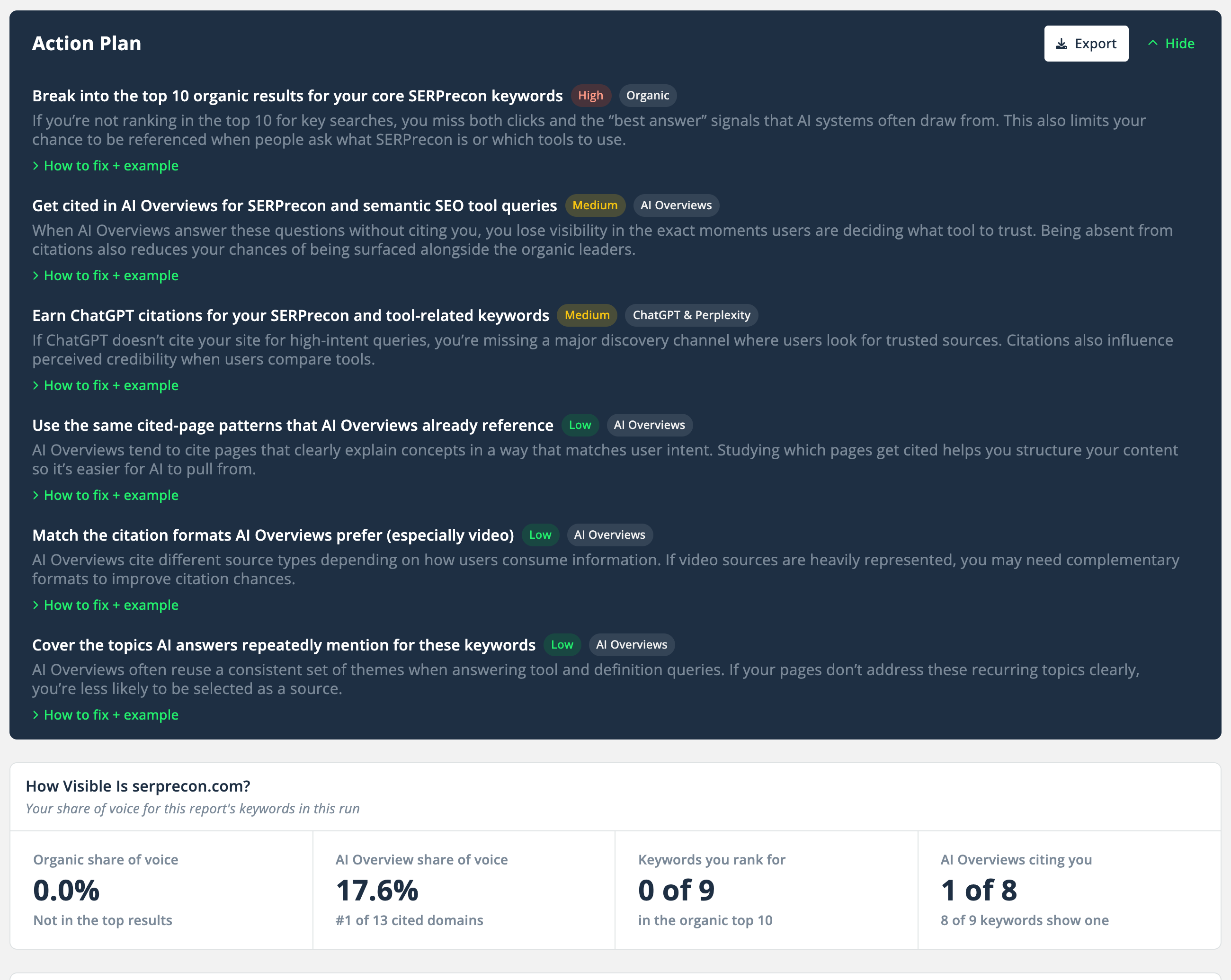
Share of voice, across every surface
01 · Share of Voice Mapping. 40+ commercial keywords tracked across Google organic, Google Shopping, and AI surfaces. Not position — true market ownership. Who's visible, who's cited, who captures intent before the click.
Competitors monitored: 11 domains
02 · AI Overview Monitoring. Citation tracking across Google AI Overviews, ChatGPT, and Perplexity. Which domains AI models trust, which entities they name, and which content structures earn retrieval across all three surfaces.
Surfaces: Google · ChatGPT · Perplexity
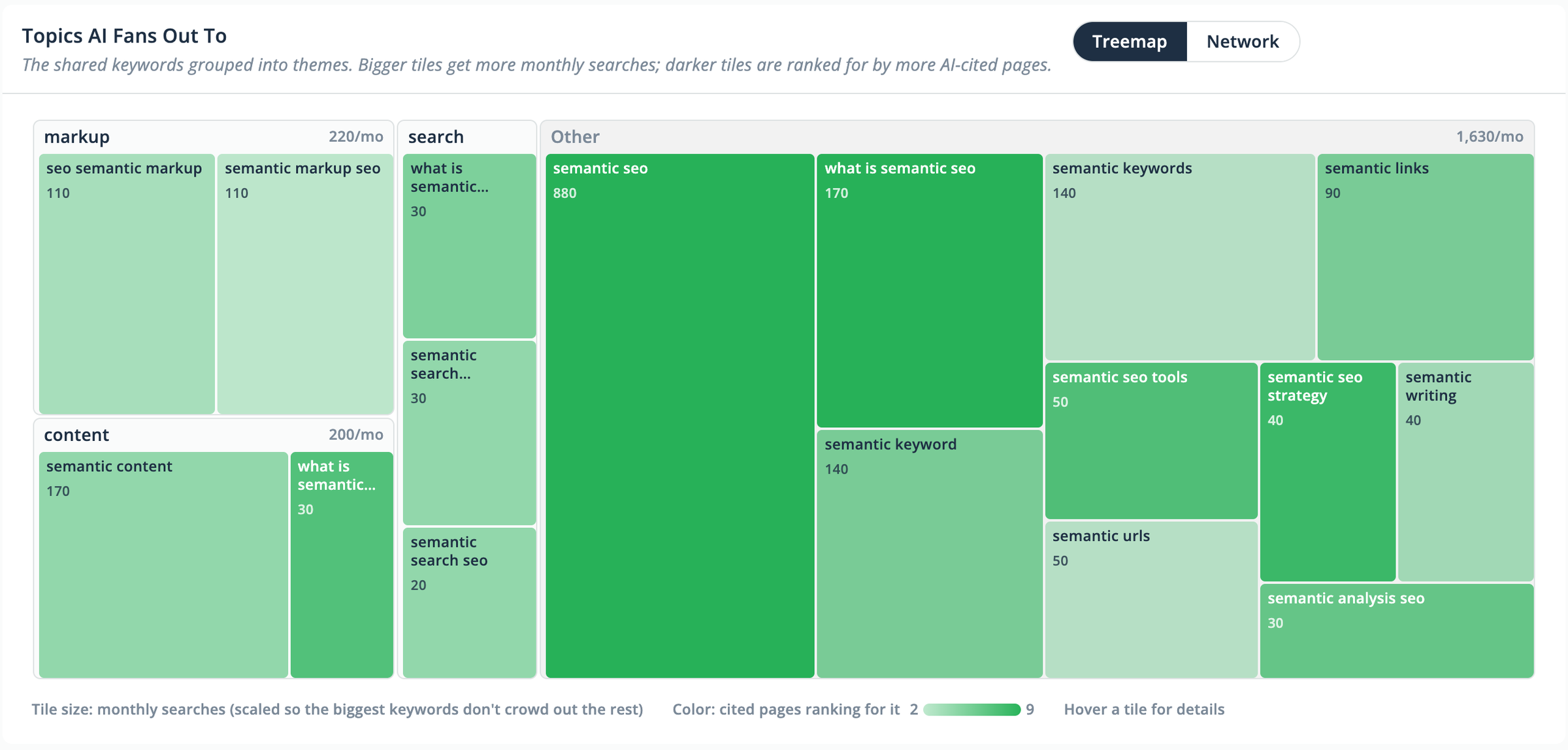
The full semantic neighborhood
03 · Query Fan-Out Analysis. Each priority keyword expanded into the full semantic neighborhood AI models associate with it. Reveals adjacent concepts a page must cover — not just the target keyword, but the entire retrieval context engines expect.
Output: landing pages · guides · taxonomy nodes
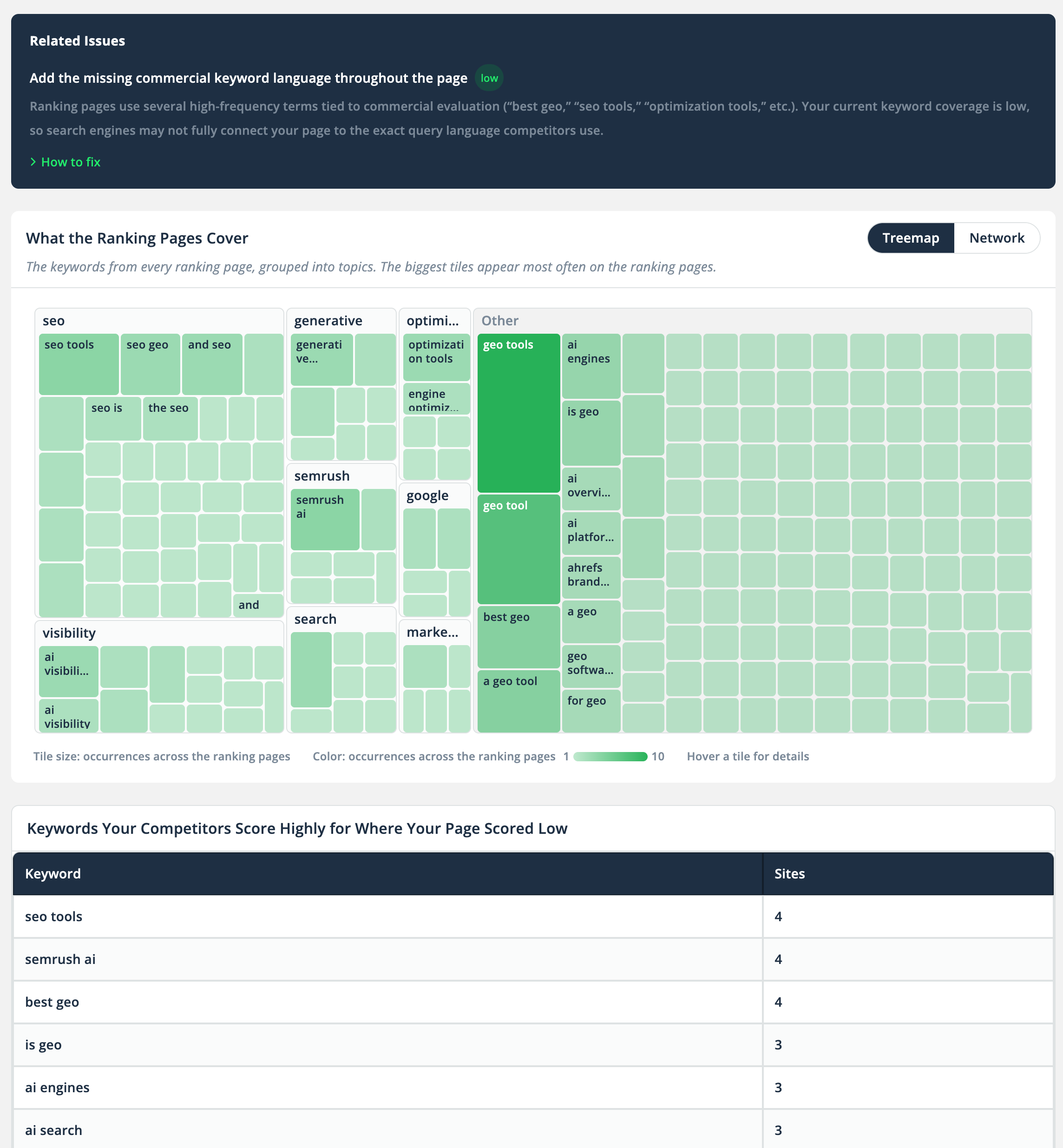
Evidence, not editorial instinct
04 · Semantic Gap Discovery. Systematic identification of concepts competitors covered that Framewell didn't — and that AI models were actively using as trust signals. Evidence-led content development from day one.
83 gaps identified · 0 previously documented
05 · Competitive Intelligence. Continuous monitoring of 11 competitor domains — big-box retailers, brand DTC sites, specialty platforms, and user forums — tracking AI citation rates, content architecture changes, and semantic expansion moves in real time.
04 · Key Findings
What the data actually showed.
05 · Results
What shipped in 90 days.
On top of the headline numbers above, every change was driven by retrieval evidence.
200+ SKUs updated
Product titles and descriptions revised based on AI intent data. Zero guesswork — every change driven by retrieval evidence.
12 new landing pages
Built directly from fan-out findings. Each validated against competitive intelligence before a word was written.
6 new taxonomy nodes
Compatibility hubs, subtype expansions, brand-specific replacement architectures. None existed before the engagement.
From rank tracking to decision infrastructure.

We stopped guessing which content would move the needle. The data told us exactly where we were invisible — and gave us the evidence to fix it, page by page.
SERPrecon as Operating System
Framewell now runs SERPrecon as its decision-support layer — prioritizing content and taxonomy work by retrieval evidence instead of editorial instinct.
The Competitive Position
By owning the specificity big-box competitors ignore, Framewell turned authoritative, extractable answers into a durable advantage in AI search.
The Ongoing Cadence
Each quarter, fresh fan-out findings feed the backlog — compounding Framewell's retrieval advantage while competitors are still discovering the gap.
Insights-powered Solutions
Get Started with SERPrecon
Evolve your SEO. Leave outdated metrics behind and start analyzing your website the way a search engine does. Start your zero-risk 7-day trial today.
About
A co-branded case study.
SERPrecon
SERPrecon is a strategic intelligence platform for measuring search visibility beyond traditional rankings. It tracks Share of Voice across organic, Shopping, and AI surfaces — and identifies exactly which problem is holding a site back: content, intent, or authority. serprecon.com
FRDTLAB
FRDTLAB is an AI growth systems and audience intelligence lab. This case study was produced as part of an ongoing strategy partnership — SERPrecon provides the data infrastructure; FRDTLAB provides the strategic framework for acting on it. frdtlab.com
About the Data
All metrics are drawn from live SERPrecon platform data across the 90-day engagement and the ongoing partnership. Client details have been anonymized at the client's request.
Co-branded case study · AI Visibility & Search Intelligence · 2026 — Client details anonymized · All metrics from live platform data.